
Story threads
Following my narrative

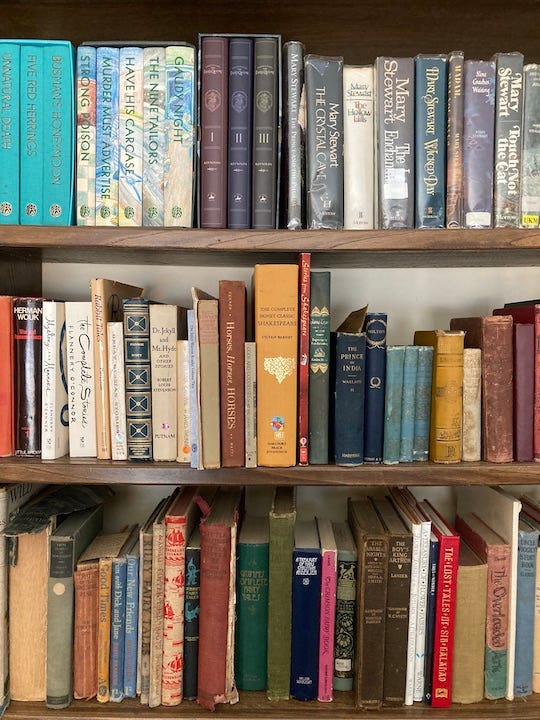
There are an awful lot of things going on in the world. A lot of them are horrible, many are beautiful, and we can’t begin to put a number to the amount of things that are completely unremarkable. When I started writing this, for instance, I was sitting in a university library writing in a notebook. It was quiet, the way a library should be, and the sun poured through the great window beside me, warming me from the outside in. A little before that I was studying for our Sunday class’s lesson in Acts. There was a couple at a nearby table chatting, as far as I could gather, about stock options. I wasn’t trying to eavesdrop—they were speaking loudly enough to be clearly heard, and I was tempted to ask them to pipe down because 1) library etiquette, and 2) I really didn’t care to hear about stock options.
But I digress. As I was saying, there are many things happening all at the same time (including conversations about stocks). Nowadays we can be instantly aware of multiple events. A headline may pop up on our phone, or someone will post a social media reel, or comment about events in a podcast. We may read someone’s post or thoughts on various events. We’re faced with a deluge of information, filtered and unfiltered, and are often asked or expected to make a judgment call no matter how much we know about the incident.
A few questions come to my mind when I’m faced with this overabundance of information. How much do I really know? How much do I need to know? Is it important to my life right now to know, understand, and draw a conclusion about the events that are happening across the globe, in another state, or even in a building on the other side of the university campus?
I think it’s good to be aware of big picture events, and to have a general idea of what is happening in the world or my country. At the same time, though, I can’t always feel responsible to do something, or even make a definitive judgment. If I try, my stress level leaps up exponentially—it’s just too much weight for one person to carry. I need to focus on the things right in front of me, and the people directly in my sphere. What is God asking of me right now? How can I be obedient to his calling on my life in this moment?
The truth of the matter is I can only live my own life, and the narrative I tell reduces this even further. You are only reading one thread of my story right now—there are plenty of details I haven’t mentioned. For example, while I was distracted by the couple talking stocks, I couldn’t help but wonder what the relationship was between this guy and girl. Were they friends? Were they dating? The guy waxed eloquently (and lengthily) in a warm baritone, not an unpleasant nasal twang, and the girl’s soprano lilted in and out with questions and comments. She certainly didn’t seem bored. I have no idea what their story was, but I kept pondering it, even as I pulled out another commentary to see if I could discover more about the apostle Paul’s message to the Ephesian elders in Acts 20.
So yes, there was more than one thread of story happening in that single moment, but I choose which one to focus on. The more I write stories, and the more I read, the more I see how authors pick and choose what parts are needed to move a narrative forward. Our study of Acts has been a great case in point for this. As our class has studied this book, we’ve seen again and again how the author, Luke, describes some events in detail, while other parts of the story are left out completely. Sometimes we go on deep dives and try to figure out what was left out and why, but usually we try to see why Luke included the parts he did. What is his point for the narrative? What does it show us about God and his plan?
I’m currently reading an epic fantasy novel where there are three point of view characters. Each chapter is from one of these character’s point of view, and the author uses this to give the reader a broader experience of all the things happening. She’s also using these various threads to keep the story moving, and so the reader can be aware of ways these different parts may come together in the end. At the same time, even with this broad scope, she doesn’t share everything with the reader. If she wrote everything that the characters experienced, the book would take a lifetime to read! There also would be numerous unimportant details that would confuse and bog down the story.
When I wrote my Daughter of Arden Trilogy, I chose to stick with one character’s point of view. Everything that happens within the pages of the books is something Maleen experiences directly, or learns from other characters. She has to navigate her life based on what she knows and understands, much like I have to navigate my own life. Interestingly, though, as the author of her story I had to know details she didn’t. In the first book, Exile, Maleen spends half of the book in a tower while a war rages outside. I realized early on that while Maleen didn’t know what was happening outside, I needed to know because it would affect Maleen’s story later in Wandering and Promise. As a result, soon after Kraig and I married we spent a good chunk of one vacation mapping out a three-year war. I still have the notes! Some of those details never made it into the books, but that was okay. Maleen didn’t need to know every detail for her narrative to be complete.
I suppose my lifelong love of books and my experience with writing have given me a way to navigate the stories in my own life and world. I can’t see all of the details that are out there, but I know that God, the Author, can. He knows the multiple narrative threads intimately, and he can work in the lives of every character in his grand story. I don’t have to worry about most of those threads, but I do need to consider my own story and walk it wisely and faithfully. I need to let go of the things I can’t control, but be willing to step up and help in the places that I can. If one of those greater world events does impact my life here and now, I’ll navigate that with my own community, and trust my Author to bring all the threads together for the best ending imaginable.
Art for the week
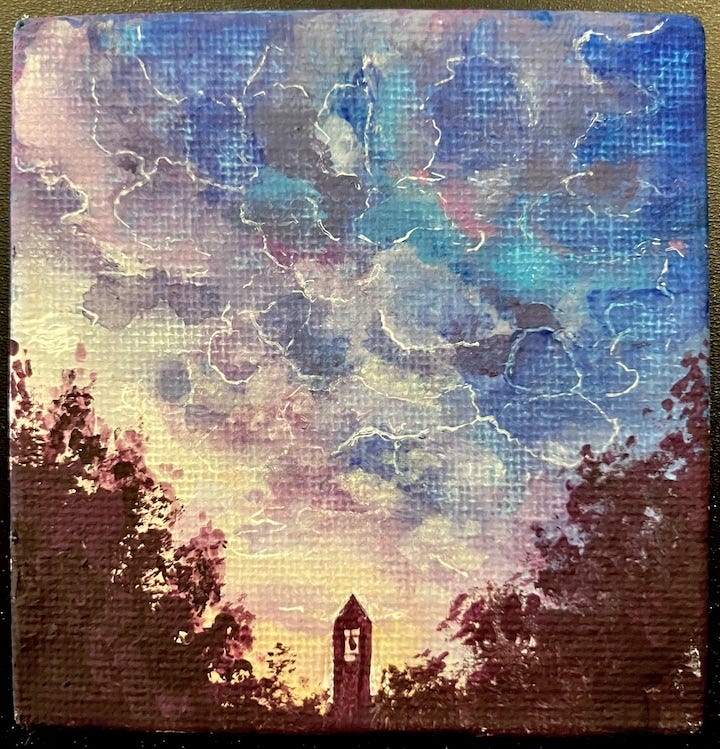
Here’s a glimpse of LeTourneau’s bell tower and evening sky, captured by my daughter, Ev, on a 3”x3” canvas.
Announcing…

I’m excited to share Flicker.Press with you, the latest creation of Bandersnatch Books’ Rachel Donahue and her husband, Mick. You can read more about it here, but the gist of the site is it’s a place where readers can preview the first chapter of various books, then buy credits to read further on. It’s a great way to get a taste of something you might be interested in. Apparently there are other sites like this out there, but their content isn’t monitored, so they include work created by AI, and a lot of garbage. Flicker.Press, on the other hand, is closely curated, and promotes what is good, true, and beautiful.
They currently have all of Bandersnatch Books’ titles on their site (so my trilogy), along with works by various authors in The Habit, the writing community I’m a member of. One fun feature is that authors can post a work in progress, and there is a place for readers to give feedback. Check it out!
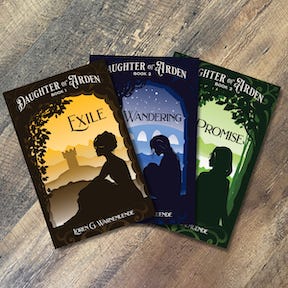
Check out Daughter of Arden at Bandersnatchbooks.com, along with other great titles.
You can find links to more of my writing at A Shaft of Sun Through the Rain and my old blog, Willing, Wanting, Waiting.

Don’t forget to check out Bandersnatch Books’ podcast, including my interview in Season 1, episode 2!
Great insight. Now please tell me the title of the epic novel you're reading. If you like it, I'm sure i will too.
It's easy to get overwhelmed, isn't it? Good thoughts!